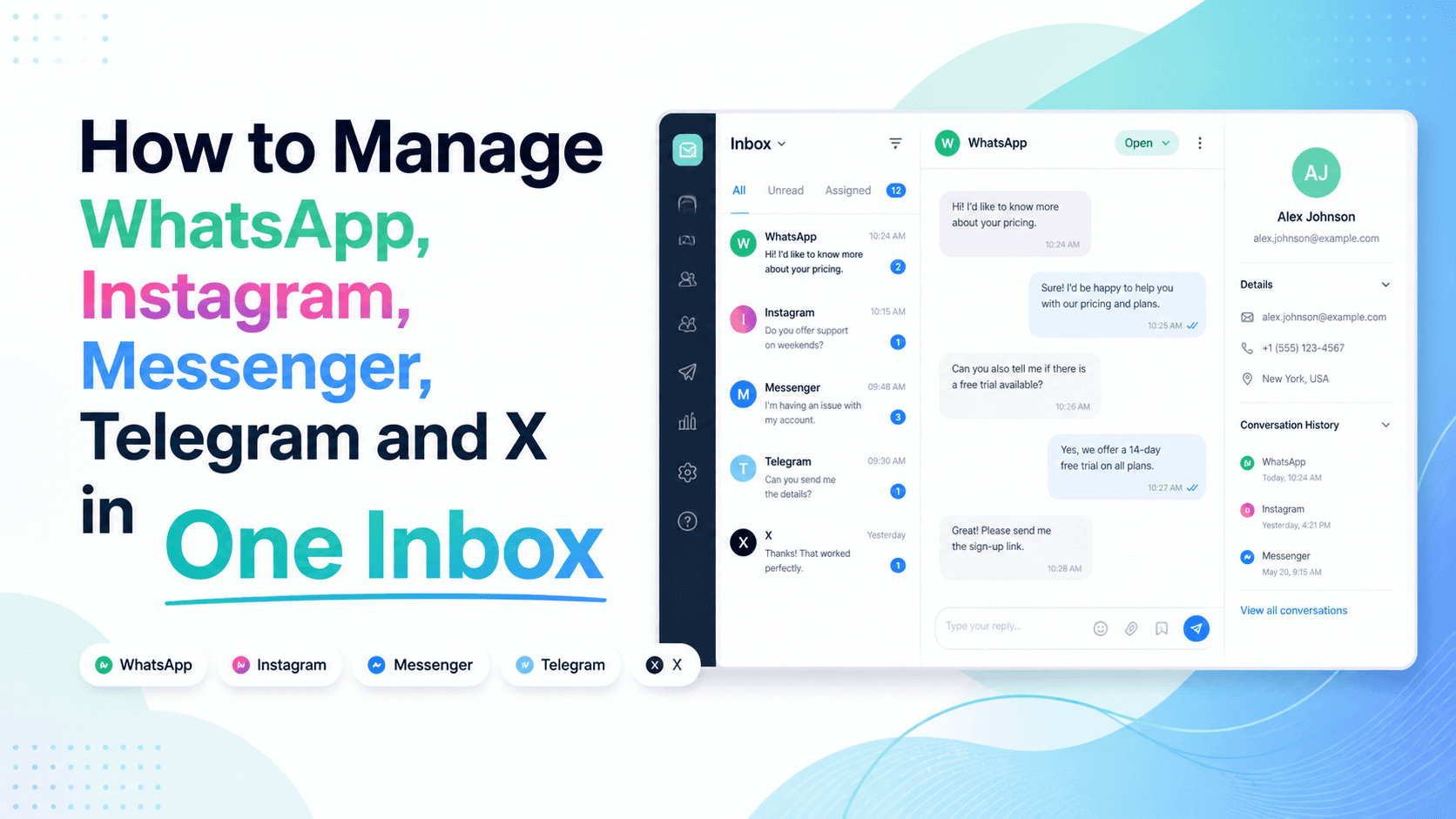
A practical guide to running multi-channel business messaging across WhatsApp, Instagram, Messenger, Telegram, and X without losing leads, context, or team accountability.
The right way to manage multi-channel business messaging is to centralize WhatsApp, Instagram, Messenger, Telegram, and X DMs in one shared inbox, then run every conversation through the same rules for ownership, response time, customer identity, automation, escalation, and reporting. Do not let each channel become its own mini support desk.
If your business answers customers in five different tabs, you do not have a messaging strategy. You have notification management.
That sounds harsh, but it is what usually happens in real teams. A sales lead asks about pricing on Instagram. The same person follows up on WhatsApp. A complaint lands in Messenger. A supplier sends a Telegram message. Someone tags the brand on X, then moves into DMs. Everyone is technically "responding," but no one can see the whole story.
Multi-channel business messaging is not about being everywhere for the sake of it. It is about giving customers the channel they already use while giving your team one operating system for ownership, context, handoff, and measurement.
The customer messaging map is wider than it was a few years ago. WhatsApp is still the most important private messaging channel in many markets, but the real customer journey does not stop there.
Meta said in April 2025 that over two billion people use WhatsApp every day and that millions chat with businesses because messaging is a faster way to get things done. Meta also reported 3.43 billion daily active people across its family of apps in March 2025, which includes Facebook, Instagram, Messenger, and WhatsApp.
DataReportal's Digital 2026 report adds another useful angle: WhatsApp ranked second by active social app users in Similarweb's app data, and global social users aged 16 and above were most likely to name WhatsApp as their favorite social platform. Instagram ranked close behind in that favorite-platform data, with Facebook also in the top three.
Telegram has also crossed into mainstream scale. Telegram's own press information says the app passed 1 billion monthly active users in 2025. And X DMs are not only a public social listening issue. X documents Direct Message endpoints for sending, creating conversations, and group messaging through the X API, which is why X belongs in the same operational conversation for brands that handle support, reputation, creator relations, or community requests there.
The takeaway is simple: customers do not care which channel your team prefers. They care whether the business remembers them, responds quickly, and gives a useful answer.
The first version of business messaging is usually informal.
One person owns the WhatsApp phone. A marketing person watches Instagram. The founder checks Facebook comments at night. Telegram is handled by whoever has the bot login. X is treated as "just social" until a complaint gets attention publicly.
That setup can work when message volume is tiny. It breaks when three things happen:
At that point, channel-native inboxes create real operational damage. Context gets trapped inside each app. Agents duplicate work. Leads are answered twice or not at all. A customer has to repeat the same order number three times. The team starts judging performance by screenshots and memory.
A unified inbox fixes the operating model, not just the screen layout.
Every channel has a different job. Treating all of them the same is one reason generic multi-channel content feels useless. Here is how teams should think about the major channels.
| Channel | What it is best for | Common risk if managed alone | What to centralize |
|---|---|---|---|
| High-intent sales, order updates, support, reactivation, local commerce | One phone or one app becomes the bottleneck | Contact identity, templates, opt-in, owner, SLA, handoff | |
| Instagram DMs | Product questions, creator traffic, comments-to-DM, social commerce | Leads disappear after campaign spikes | Lead source, product interest, tags, assignment |
| Messenger | Facebook page support, local service inquiries, older audience segments | Page admins reply without shared context | Page ownership, customer history, response quality |
| Telegram | Communities, groups, bots, international audiences, privacy-sensitive users | Bot messages and human replies split into separate tools | Bot handoff, group context, support queue |
| X DMs | Public complaint recovery, brand support, creator and partner conversations, real-time issues | Public mentions and private follow-up are disconnected | Mention-to-DM workflow, escalation, reputation notes |
The goal is not to force every customer into one channel. The goal is to keep your internal workflow consistent after the customer chooses a channel.
A good multi-channel inbox is not just a list of messages. It should answer five operational questions immediately.
The same person may appear as a WhatsApp number, Instagram handle, Facebook profile, Telegram username, X account, and email address. If those identities stay separate, the team loses memory.
Your inbox should let the team connect channel identities into one customer profile. That profile should show prior conversations, tags, notes, lead status, source, owner, and any relevant CRM fields.
This matters most when a customer changes channels mid-journey. A buyer may discover you on Instagram, ask for pricing on WhatsApp, complain on X, and later send payment proof by email. If each channel has a different history, every reply starts cold.
Most missed messages are not missed because nobody cares. They are missed because ownership is unclear.
Every open conversation should have one of three states:
Avoid the dangerous middle state where "someone should reply." That is how high-intent leads disappear.
Response time should not be measured only at the channel level. It should be tied to intent and customer value.
A refund request, VIP complaint, abandoned checkout, and new wholesale inquiry should not sit in the same generic queue. A strong setup uses channel plus intent:
This is where unified routing becomes more useful than app switching.
Automation should remove repetitive work without pretending every conversation is simple.
Good first automations include:
Riskier automations include refund approval, policy exceptions, legal claims, payment disputes, angry customer handling, or promises about delivery dates that the operations team cannot verify.
The best automation feels specific. The worst automation says, "We understand your concern" and then does nothing.
A multi-channel inbox should help leadership answer practical questions:
Without those answers, the business is just collecting messages.
Many teams separate "social media" from "customer messaging." That is a mistake when X is part of the customer journey.
X often matters in four cases:
The important workflow is not only "reply to X." It is public-to-private continuity.
A practical X DM process looks like this:
That is very different from letting the social media manager handle everything in a separate inbox.
Use this setup as the baseline for WhatsApp, Instagram, Messenger, Telegram, X, email, and web chat.
List every place where customers can message the business. Include official accounts, branch accounts, old Facebook pages, Telegram bots, web chat widgets, X accounts, shared email inboxes, and personal numbers that still receive customer messages.
Then mark each channel as active, risky, duplicate, or retired. Do not connect messy channels before you know who owns them.
Decide how contacts should be matched. Phone number, email, social handle, order ID, and CRM ID can all help. The rule should be simple enough for agents to trust.
When the system cannot confidently merge identities, keep the records separate and let the team link them manually. Bad merging is worse than no merging.
Create queues around real work, not departments on an org chart. Common queues include sales, support, billing, delivery, bookings, VIP, partnerships, and escalation.
Each queue should have a default owner, backup owner, business hours, SLA, and clear handoff rules.
Tags are only useful when they are consistent. Start with a small taxonomy:
Avoid creating 80 tags in week one. Teams stop using systems that require too much classification.
Start with low-risk automation, then expand.
Layer one: acknowledgements, office-hours replies, missing-info collection, and routing.
Layer two: AI summaries, suggested replies, lead qualification, and follow-up reminders.
Layer three: approved template sends, campaign replies, customer lifecycle flows, and carefully monitored bot responses.
The team should always know when automation answered, when a human answered, and when a customer needs escalation.
The first 30 days should be about finding operational leaks.
Review:
This is where the inbox becomes a management system instead of a message collector.
Imagine an ecommerce brand launching a new product.
Instagram creates awareness. Customers ask about sizes and availability in DMs. WhatsApp receives serious purchase questions and payment follow-ups. Messenger handles existing Facebook page customers. Telegram carries community announcements. X gets real-time complaints when the checkout page slows down.
In separate apps, the team sees chaos:
In one inbox, the flow is different:
That is the real value of multi-channel messaging. It turns scattered attention into an operating rhythm.
Do not buy a unified inbox just to recreate the same mess in a new interface.
Avoid these mistakes:
The platform is only as good as the workflow around it.
OnSync is built for teams that need one place to manage customer conversations across WhatsApp, Instagram, Messenger, Telegram, X, and other customer channels.
The practical value is not "more channels." It is cleaner work:
For a small team, this prevents missed leads. For a growing team, it creates accountability. For an agency or operator managing multiple brands, it makes channel expansion manageable instead of chaotic.
Multi-channel business messaging is the practice of receiving and replying to customer conversations across channels such as WhatsApp, Instagram, Messenger, Telegram, X, email, and web chat while managing them through one consistent team workflow.
Not always. A unified inbox centralizes messages. An omnichannel platform should also preserve customer identity, history, routing, automation, reporting, and context across channels. The inbox is the starting point, but the workflow around it is what creates the business value.
It depends on the message. Public complaints and account issues should usually go to support or escalation. Creator, partnership, and campaign conversations may belong with marketing. The important part is that X DMs are visible in the same customer record and routing system.
Start with the channel where customers already show buying or support intent. For many businesses that is WhatsApp. For social commerce it may be Instagram. For community-led products it may be Telegram. For brands with public reputation issues, X may need earlier operational coverage.
Use automation for speed and structure, not for pretending every issue is solved. Start with acknowledgements, routing, missing-information collection, summaries, and suggested replies. Expand only after you have clear escalation rules and quality review.
Customers do not experience your business as WhatsApp, Instagram, Messenger, Telegram, X, email, and web chat. They experience one brand.
If the brand forgets context between channels, the customer feels it. If the team argues about who should reply, the customer waits. If automation sends a vague answer, the customer loses trust.
The fix is not another notification tab. It is one messaging workflow with clear ownership, shared context, careful automation, and channel-level reporting.
That is how multi-channel messaging becomes a business system instead of a daily scramble.
Transform your business communication with OnSync's powerful WhatsApp automation platform.
| Email and web chat | Longer-form support, website conversion, account issues | Threads become detached from social history | Contact timeline, issue status, attachments |