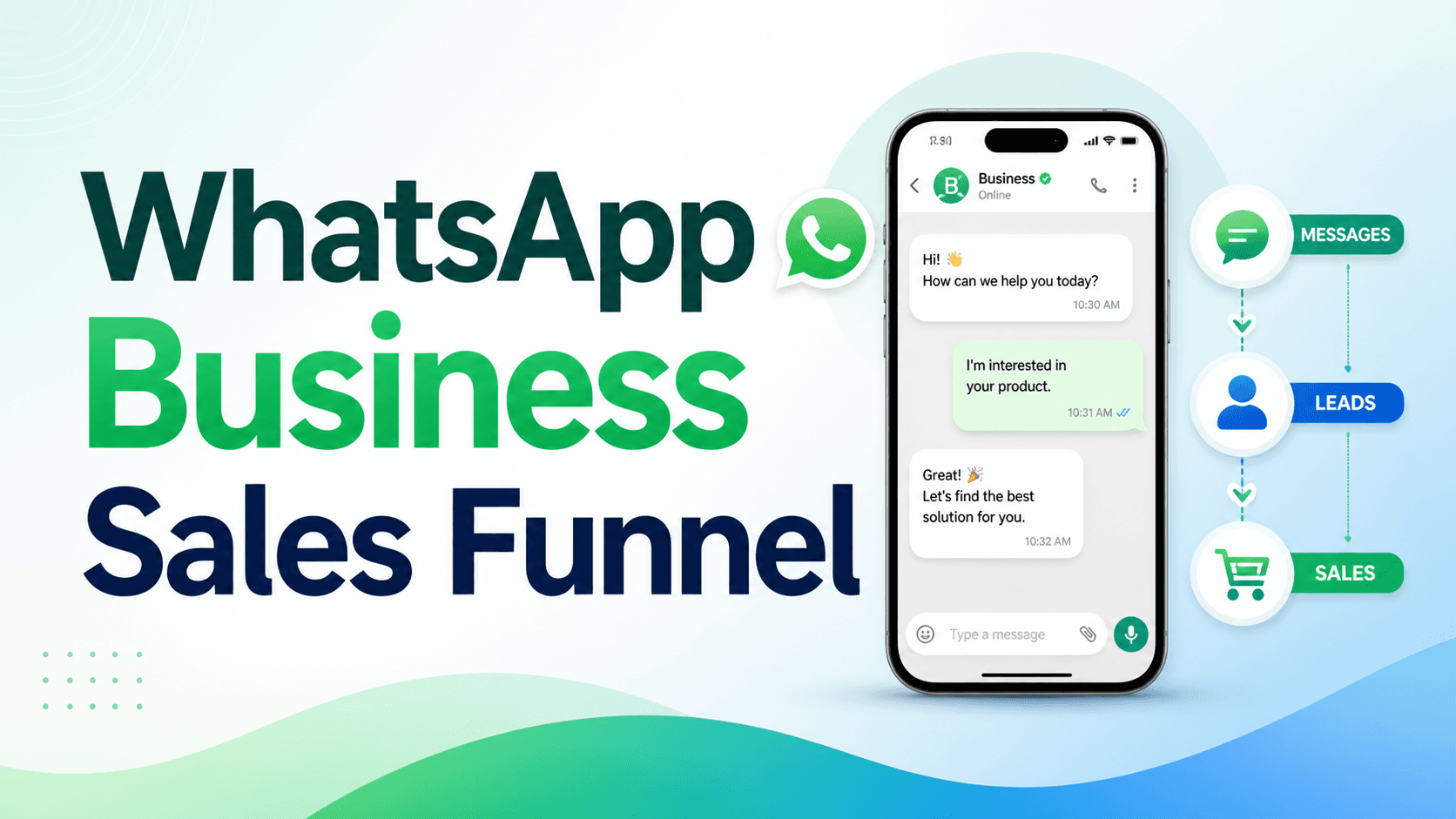
Build a WhatsApp sales funnel with opt-ins, templates, routing, CRM tracking, and compliant follow-up. A practical 2026 guide for sales and ecommerce teams.
A WhatsApp Business sales funnel is the process for turning a WhatsApp inquiry into a qualified opportunity, purchase, booking, or renewal. The strongest funnels combine clear opt-ins, useful first replies, short qualification questions, approved message templates for outbound follow-up, human handoff for high-intent or sensitive conversations, CRM tracking, and post-purchase follow-up.
A good WhatsApp sales funnel does not feel like a drip campaign copied into chat. It feels like a helpful conversation that remembers context, asks the right questions, and knows when a human should step in.
That is the difference between a WhatsApp number that receives leads and a WhatsApp sales system that can be measured. The channel is personal, fast, and easy for customers to use, but it also has rules: opt-ins matter, outbound messages often need approved templates, pricing depends on message category and country, and the 24-hour customer service window shapes what your team can send.
This guide is written for ecommerce teams, service businesses, agencies, and sales teams that already get customer conversations through WhatsApp and want a cleaner funnel from first message to closed sale. It removes the fake performance claims that usually make WhatsApp marketing articles sound impressive but unhelpful. Use your own analytics to prove lift; use this playbook to build the system.
The older version of this page made three common SEO mistakes.
First, it treated an old year as the headline even though WhatsApp Business Platform rules and pricing are reviewed often. A dated headline can make an otherwise useful page look stale in search results.
Second, it used unsupported numbers such as higher conversion rates, monthly revenue claims, and guaranteed return timelines. Those numbers may attract clicks, but they can also weaken trust if Google or a buyer cannot verify the claim.
Third, it described a generic funnel: capture lead, nurture, convert, retain. That structure is not wrong, but it misses what actually makes WhatsApp different: template approval, conversation windows, routing, human handoff, opt-in language, CRM sync, and the fact that customers expect a real answer quickly.
For the current version of WhatsApp Business, build around the operating reality of the platform: customers start many conversations, businesses use approved templates for many outbound messages, pricing and deliverability depend on category and policy fit, and the best results come from useful follow-up rather than pressure.
A normal sales funnel often assumes the business controls the pace. You publish a landing page, collect an email, send automated follow-ups, and wait for the buyer to book or purchase.
WhatsApp is different. The customer can interrupt, ask a specific question, send a voice note, share a screenshot, negotiate, ask for a human, or disappear after one reply. That makes WhatsApp powerful, but it also makes generic automation risky.
A WhatsApp funnel needs four layers working together.
| Layer | What it does | Why it matters |
|---|---|---|
| Entry point | Click-to-WhatsApp ads, website chat buttons, QR codes, product pages, social links, receipts, and post-purchase messages | Shows where the lead came from and what promise brought them in |
| Conversation workflow | Welcome reply, qualification, recommendation, objection handling, checkout or booking, and follow-up | Gives the customer a clear next step instead of a vague greeting |
| Compliance and delivery | Opt-in capture, approved templates, customer service window rules, and message category discipline | Keeps outbound follow-up usable and reduces rejected or misclassified messages |
| Revenue operations | Assignment, CRM sync, lead status, notes, reminders, reporting, and handoff rules | Lets a team manage WhatsApp as a pipeline, not a shared phone |
When one layer is missing, the funnel leaks. A great welcome message does not help if nobody owns the lead. A CRM record does not help if the conversation context stays inside one agent's phone. Automation does not help if it sends the wrong template at the wrong time.
The funnel starts before the first message. A weak WhatsApp entry point says, "Chat with us." A stronger entry point tells the customer why they should start the chat.
Examples:
That small promise improves the first conversation because the agent or automation knows the customer intent immediately.
Capture these fields when possible:
| Field | Example | How it helps |
|---|---|---|
| Source | Website pricing page, Instagram ad, QR code in store, product page | Shows which entry points create qualified conversations |
| Intent | Quote, availability, support, booking, order status, product advice | Routes the customer to the right workflow |
| Consent context | What the customer clicked or agreed to receive | Supports compliant follow-up |
| Product or service context | SKU, plan, location, appointment type, order ID | Reduces repeated questions |
| Owner | Sales, support, branch, ecommerce, agency account manager | Prevents duplicate replies and missed handoffs |
If you use Click-to-WhatsApp ads or website buttons, avoid sending everyone into the same blank inbox. Tag the source and pass the context into the conversation whenever your tooling allows it.
WhatsApp qualification should be short. The goal is to learn enough to route the conversation and recommend the next step, not to interrogate the buyer.
A practical qualification sequence asks one question at a time:
You can automate parts of this, but keep the tone conversational. If the customer already provided the answer, do not ask again. Repeating questions is one of the fastest ways to make automation feel careless.
A stronger first reply looks like this:
A weaker reply looks like this:
The second version may collect data, but it does not feel like sales help. Start with the smallest question that moves the conversation forward.
After qualification, the funnel should stop being generic. The customer should see a specific next step.
For ecommerce, that may be:
For services, that may be:
For B2B sales, that may be:
A useful WhatsApp recommendation is usually shorter than a landing page and more specific than a canned reply. The customer should feel that the answer used what they already said.
A WhatsApp funnel loses momentum when the customer has to repeat themselves on another channel. If the buyer is ready, give them a direct path to purchase, booking, or sales handoff.
Closing actions can include:
Do not force every close to be automated. A human should step in when the deal is high value, the customer is frustrated, the customer asks for an exception, or the answer depends on private account details.
A good closing message is specific:
A weak closing message is vague:
The first message gives a next step. The second puts the work back on the buyer.
Follow-up is where many WhatsApp funnels go wrong. The channel feels personal, so irrelevant reminders can damage trust quickly.
Use follow-up when there is a real reason:
Before sending outbound follow-up, check whether the message needs an approved template and whether the customer has opted in to receive that type of message. Meta?s WhatsApp Business Platform documentation separates template use, message categories, and pricing rules, so teams should review the official docs instead of relying on old blog summaries.
Useful references:
This is the part many sales funnel articles skip. It is also the part that affects whether your funnel can operate reliably.
| Rule or concept | Practical meaning for the funnel |
|---|---|
| Customer service window | When a customer messages your business, there is a limited window where free-form service replies are allowed. Design your workflow to answer quickly and capture the next step while the conversation is active. |
| Message templates | Many business-initiated messages outside the service window require approved templates. Write templates for real customer moments, not generic promotions. |
| Message categories | Marketing, utility, authentication, and service messages have different purposes and pricing treatment. Do not use a marketing template for an operational update. |
| Opt-in | Customers should understand what they are agreeing to receive. Store the source and context of opt-in when possible. |
| Quality and policy fit | Relevance, complaint rate, and template quality matter. Sending broad, poorly targeted follow-ups can hurt deliverability and trust. |
| Pricing | Meta pricing varies by country and message category and may change. Link your finance assumptions to the official rate cards, not a static SEO article. |
If a number is not from your own analytics or an official rate card, keep it out of the page. It is better to say "measure conversion by source and stage" than to publish a universal conversion claim that will not match your business.
Templates should feel like helpful service moments. The best templates are short, specific, and easy to approve because the category matches the purpose.
Use this when the customer opted in and you are continuing a sales conversation.
This works because it gives the customer a simple choice instead of a vague "just checking in."
Use operational templates for operational updates. Do not mix promotional language into a utility-style message.
This keeps the relationship useful after the sale and gives support a clean trigger.
Automation should remove repetitive work, not remove judgment.
Start with these automations:
Be careful with these automations:
A human-written funnel does not mean every message is typed manually. It means the system knows when automation is enough and when a person needs to own the moment.
WhatsApp conversations often create revenue, but many teams cannot prove it because the data stays in the inbox. Fix that before you optimize copy.
Track these fields in your CRM or shared inbox:
| Field | Why it matters |
|---|---|
| Lead source | Shows which ads, pages, QR codes, and campaigns create sales conversations |
| Conversation owner | Makes follow-up accountable |
| Funnel stage | Lets managers see where conversations stall |
| Last customer intent | Helps the next agent continue without asking again |
| Next step | Prevents promising follow-up and forgetting it |
| Revenue or booking outcome | Connects WhatsApp work to business results |
| Template used | Shows which outbound messages drive useful replies |
| Opt-in source | Helps with consent and auditability |
Without this layer, a WhatsApp funnel becomes a busy inbox with no learning loop.
Do not optimize against universal claims like "WhatsApp converts better than email" unless you have your own evidence. Different businesses, countries, offers, price points, and lead sources behave differently.
Use internal metrics that show whether your funnel is improving:
If you want to publish performance numbers later, use a clear source: your own date range, sample size, segment, and methodology. Otherwise, keep public SEO copy practical and claim-free.
If the button only says "WhatsApp us," the customer may start with a vague message and the team has to dig for intent. Improve the promise on the page, ad, or QR code.
Long forms inside WhatsApp feel heavy. Ask the next useful question, not every possible question.
A shared phone or unassigned inbox creates duplicate replies and missed follow-up. Every qualified conversation needs an owner or queue.
A generic reminder after a detailed conversation feels automated in the worst way. Reference the actual request or do not send the reminder.
Templates should be part of funnel planning. If you wait until you need outbound follow-up, you may be blocked by approval, category fit, or unclear opt-in.
More messages do not always mean more revenue. Track stage movement and outcome.
Use this as a rollout sequence, not a promise that every company can launch in a fixed number of days.
List the places where customers already start WhatsApp conversations. Pull real examples from the inbox: product questions, pricing questions, delivery questions, booking requests, complaints, and quote requests.
Create a simple stage map: new lead, qualified, recommendation sent, quote or checkout sent, won, lost, post-purchase. Decide who owns each stage and when the conversation moves to another queue.
Create a welcome reply for each major intent. Keep it short, useful, and specific to the source. A product page lead should not receive the same message as a support request.
Write follow-up templates for quote reminders, appointment confirmation, payment reminders, back-in-stock updates, and post-purchase help. Keep each template aligned with its real category and use case.
Make sure source, owner, stage, next step, and outcome are captured. This is what lets you improve the funnel after launch.
Start with one product line, branch, campaign, or sales team. Review conversations manually. Look for repeated questions, unclear handoffs, template rejection, slow replies, and places where customers stop responding.
A WhatsApp funnel improves through small operational fixes: better source tagging, shorter questions, clearer payment links, faster human handoff, and fewer irrelevant follow-ups.
OnSync is built for teams that want WhatsApp to work as a shared revenue and support channel instead of a single phone number. The practical pieces are:
The goal is not to automate every buyer. The goal is to make every real conversation easier to answer, track, and move forward.
A WhatsApp Business sales funnel is the workflow that turns WhatsApp conversations into qualified leads, purchases, bookings, renewals, or support handoffs. It includes entry points, opt-in context, replies, qualification, templates, routing, CRM tracking, and follow-up.
Small teams can start with the WhatsApp Business app, but teams usually need the WhatsApp Business Platform or a provider built on it when they require multiple agents, automation, CRM integration, reporting, and approved templates for outbound follow-up.
No. Follow-up depends on opt-in, customer context, template approval, message category, and current platform rules. Use official Meta documentation and your provider?s guidance before sending outbound campaigns.
Start with lead source, first response time, qualification completion, owner, next step, quote or checkout sent, won or lost outcome, template reply rate, and opt-out or complaint signals.
Use AI first for drafting, summaries, routing, intent detection, and suggested next steps. Let humans handle high-value deals, complaints, exceptions, sensitive account questions, and anything where a wrong answer can damage trust.
A WhatsApp sales funnel works when it respects the channel. Keep the first promise clear, ask fewer but better questions, use templates for real follow-up moments, route serious conversations to humans, and measure outcomes from your own data.
That approach is less flashy than claiming a universal conversion lift, but it is the kind of content and operating model that can survive buyer scrutiny, platform changes, and search quality reviews.
Transform your business communication with OnSync's powerful WhatsApp automation platform.