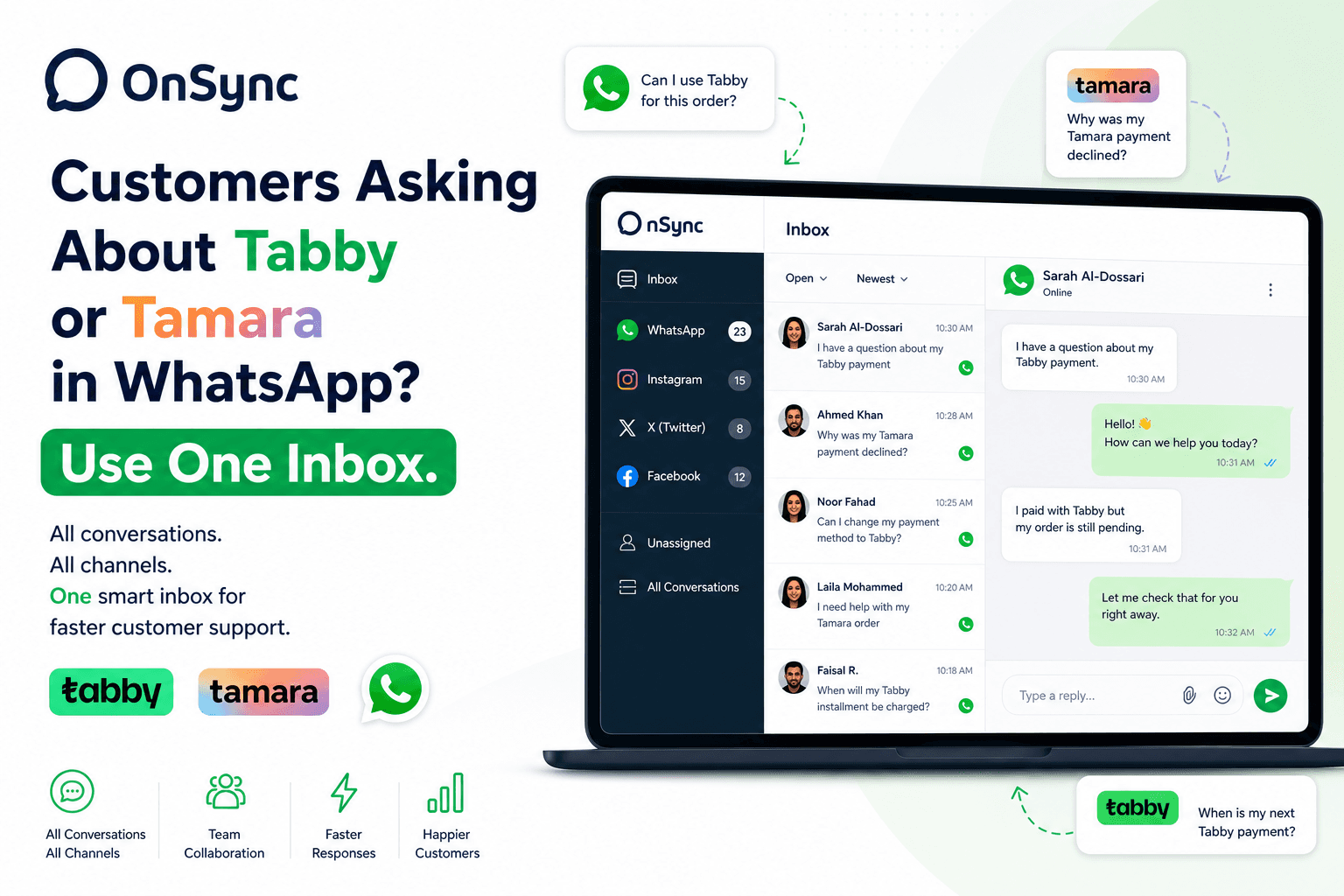
If customers ask your store questions like "Do you support Tabby?", "Can I pay with Tamara?", "Why did the installment option disappear?", or "How do refunds work if I paid in installments?", the problem is not only a payment question. It is a conversation management problem.
If customers ask your store questions like "Do you support Tabby?", "Can I pay with Tamara?", "Why did the installment option disappear?", or "How do refunds work if I paid in installments?", the problem is not only a payment question. It is a conversation management problem.
Across Gulf ecommerce markets, buy now, pay later has become a normal part of the checkout experience. Tabby offers payment options that can split purchases based on the plan available at checkout, and Tamara describes itself as a shopping and payment platform that helps customers split payments in Saudi Arabia and the region.
Customers do not experience that as a policy page. They experience it as a direct question in a chat:
These questions usually come right before purchase or immediately after checkout. They may start from an Instagram ad, move to WhatsApp, and continue later through Facebook Messenger. If the team treats each message as an isolated chat, it becomes hard to answer basic operational questions: who replied, what did they say, did anyone promise approval, did the customer complete payment, and is the order actually closed?
Tabby and Tamara questions do not belong neatly to one team. Sales wants to close the order quickly. Support needs to explain policy accurately. Operations may need to check order status, payment status, fulfillment, or returns.
When WhatsApp sits on one device, Instagram belongs to another employee, and Facebook or Telegram has no clear owner, predictable problems appear:
The issue is not Tabby or Tamara. The issue is how the store manages conversations around them.
A shared inbox turns customer channels from separate accounts into a team workspace. Instead of moving between WhatsApp, Instagram, Facebook, Telegram, internal notes, and personal phones, every conversation appears in one place with a clear owner and status.
With OnSync, an ecommerce team can use a simple workflow for installment payment questions:
That turns a payment question into an organized part of the customer journey, not a stray message.
Saved replies reduce hesitation and keep answers consistent across WhatsApp, Instagram, Facebook, and Telegram. Keep them updated with your store policy and the latest payment provider terms.
Yes, you can choose the available payment method at checkout if it applies to your order. If the option does not appear, send us a screenshot of the checkout page or your cart details and we will help you review the next step.
The option may depend on order value, product type, customer location, or the payment provider's approval process. Send us your order number or a screenshot of the checkout page and we will help you check what happened.
If the order was already confirmed with another payment method, we may need to review the order status before changing anything. Send us the order number and we will tell you the available next step.
Refunds depend on the store policy, order status, and payment method used. Once the return is approved by our team, the payment provider updates the transaction according to its official process.
You can try the discount code at checkout. If the system accepts the code and the payment option appears, you can continue. If the option disappears, send us a screenshot of the cart and we will review it.
OnSync does not change Tabby or Tamara terms, and it does not make approval decisions on behalf of payment providers. It helps your team respond to the customer conversations those payment options create.
Messages from supported customer channels appear in one inbox, even when several teammates are working at the same time. This matters when a customer asks about Tabby in WhatsApp, sends a product screenshot on Instagram, and follows up about delivery on Facebook.
Pre-purchase questions can go to sales. Existing order questions can go to support. Sensitive cases like refunds, payment failure, or complaints can be assigned to a supervisor.
Instead of letting every teammate explain payment rules differently, you can create a small library of approved replies for Tabby and Tamara questions. That protects the customer experience and reduces accidental promises.
Tags such as "Tabby", "Tamara", "payment declined", and "refund" help managers understand demand. Are payment questions increasing near payday? Are they tied to specific products? Does the checkout page need clearer wording?
Customers do not think in departments or channels. They expect the store to remember the full story. A unified inbox preserves that context when a conversation moves from payment to shipping to returns.
Imagine a fragrance and gifting store receiving daily messages like:
Without one inbox, a sales agent replies from a phone, then asks support to check the order in another chat, and the context disappears when the customer comes back two hours later from another channel.
With OnSync, the store can create a cleaner workflow:
The result is not only a faster reply. The customer feels that the store is organized.
Even with a strong inbox workflow, your team needs disciplined answers. Avoid these mistakes:
The safer approach is a set of short approved replies, updated links, and a clear escalation path.
| Situation | Separate channels without one inbox | One inbox with OnSync |
|---|---|---|
| Customer asks about Tabby or Tamara | Agent replies based on memory | Approved saved reply |
| Payment option does not appear | Customer waits or repeats the question | Case is tagged and assigned |
| Pre-purchase question | May get lost in busy DMs | Routed to sales with context |
| Existing order or return | Agent searches manually | Conversation history stays visible |
| Manager follow-up | Hard to measure | Tags and reports show volume |
If you want to improve conversion from customer messaging, do not only count messages. Track signals closer to purchase:
These signals help you improve checkout content, FAQ pages, and team training.
To reduce repeated questions, make payment information clear before the customer reaches a messaging channel:
Even with strong site content, chat remains where many customers make the final decision. That is why your team needs an organized inbox, not just better website copy.
This article focuses on managing customer conversations about Tabby and Tamara inside one shared inbox. If you need a specific integration such as syncing payment or order status, that can be evaluated based on your ecommerce platform and payment setup.
Yes. You can prepare automated replies or saved replies for common keywords like "Tabby", "Tamara", "installments", and "payment". Keep automated answers general and accurate, and route sensitive cases to a teammate.
Yes. A small store can lose revenue when one conversation is missed or two teammates reply to the same customer. A unified inbox helps even when the team has only two people.
Not always. Use the provider name when the customer asks about a specific option. If the customer asks generally about payment methods, send the updated checkout or payment policy link.
Start by bringing supported customer conversations into OnSync. Then create tags for payment questions, write five to eight saved replies, and train the team on when to answer and when to escalate. After two weeks, review question volume, response time, and conversion by channel.
Tabby and Tamara questions in WhatsApp are a sign of purchase intent, not just another support task. The customer who asks about payment is often close to buying or needs more confidence before completing checkout.
If those questions stay scattered across phones and social accounts, your team loses speed, context, and measurement. When they flow into one shared inbox, they become an organized part of the sales and support journey.
Use OnSync to turn customer channels into one team inbox, and make every Tabby or Tamara question a chance for a faster reply, clearer experience, and higher conversion.
Transform your business communication with OnSync's powerful WhatsApp automation platform.